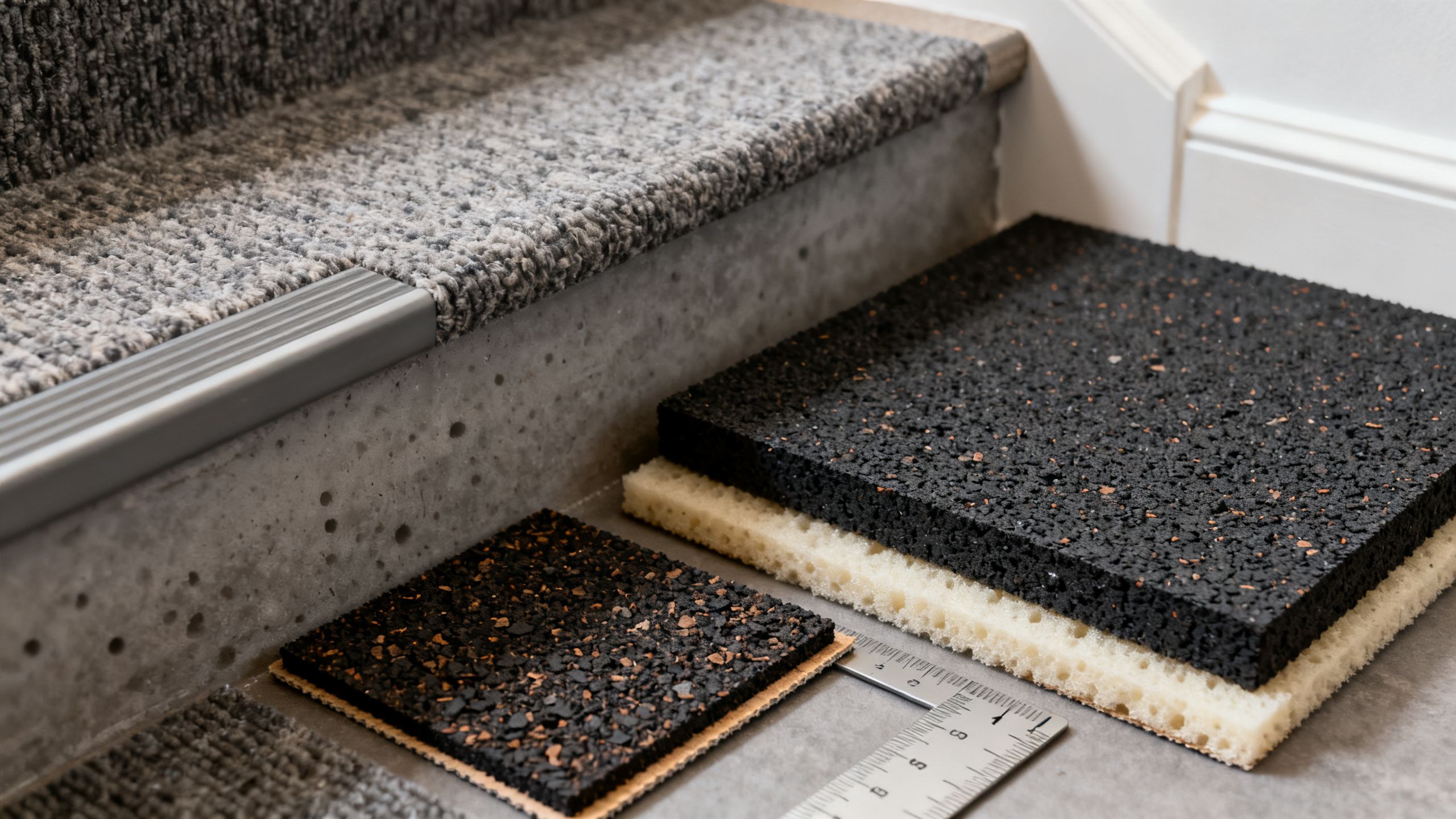




Thicker and dearer underlay isn’t automatically better underlay. After fitting thousands of floors, we often tell customers in Bristol that a sensible mid-range underlay is the better choice—and that the thickest premium option can be wasted money or even the wrong product for stairs.
At Seamless Floors, we supply and fit carpet and underlay across Bristol, Bath and surrounding areas. We fit underlay every day, so our advice is based on what works under real carpets, on real stairs and in real homes—not on selling the most expensive roll.The underlay advice you’ll read everywhere
Most flooring guides tell you to buy the thickest, softest and most expensive underlay you can afford. The usual number is 12mm premium underlay, presented as the safest route to comfort, insulation and a longer-lasting carpet. There is some truth in that advice, but much of it comes from retailers who profit when you buy more. The important question is not “What is the thickest underlay available?” It is “What underlay suits this carpet, this room and this subfloor?” If you are still weighing up carpet options, our guide to choosing the right carpet for your Bristol home explains why the carpet itself often deserves more of the budget.What most guides tell you vs what we actually tell customers
| What most guides say | What we tell customers |
|---|---|
| Always buy the thickest underlay you can afford. | Buy the right thickness and density for the room. |
| 12mm premium underlay is best everywhere. | Around 10–11mm PU foam is the sweet spot for many bedrooms and lounges, but stairs usually need something firmer and thinner. |
| Softness is the main sign of quality. | Density, resilience, tog rating and the carpet manufacturer’s specification matter just as much. |
| Spend more on underlay before considering the carpet grade. | If the budget is limited, a better carpet over a suitable medium underlay is often the more durable choice. |
Why we say this
Underlay has three main jobs: cushioning, insulation and sound reduction. The improvement from a cheap, thin foam to a decent 10 or 11mm PU underlay can be dramatic. The improvement from that sensible mid-range product to the thickest option in the brochure is often much harder to notice. There are four practical reasons we do not recommend premium-thick underlay everywhere:- The benefits flatten out. The first upgrade can transform how a floor feels, because you are moving away from a weak, thin base. After that, extra thickness often brings smaller gains in comfort, insulation and sound reduction.
- Too much give can work against the carpet. If the underlay compresses and flexes excessively, the carpet backing moves more than it was designed to. Over time, that can contribute to tufts loosening and traffic lines appearing sooner.
- Stairs need control rather than maximum softness. A thick, soft underlay can allow the carpet to roll over the stair nosing. The tread can feel spongy and the edge may not hold the clean shape you want underfoot.
- The carpet grade may be a better use of the money. Underlay is usually one of the smaller lines on the quote. Doubling its price may add less value than moving up to a better carpet that will be seen and walked on for years.
Density matters more than thickness
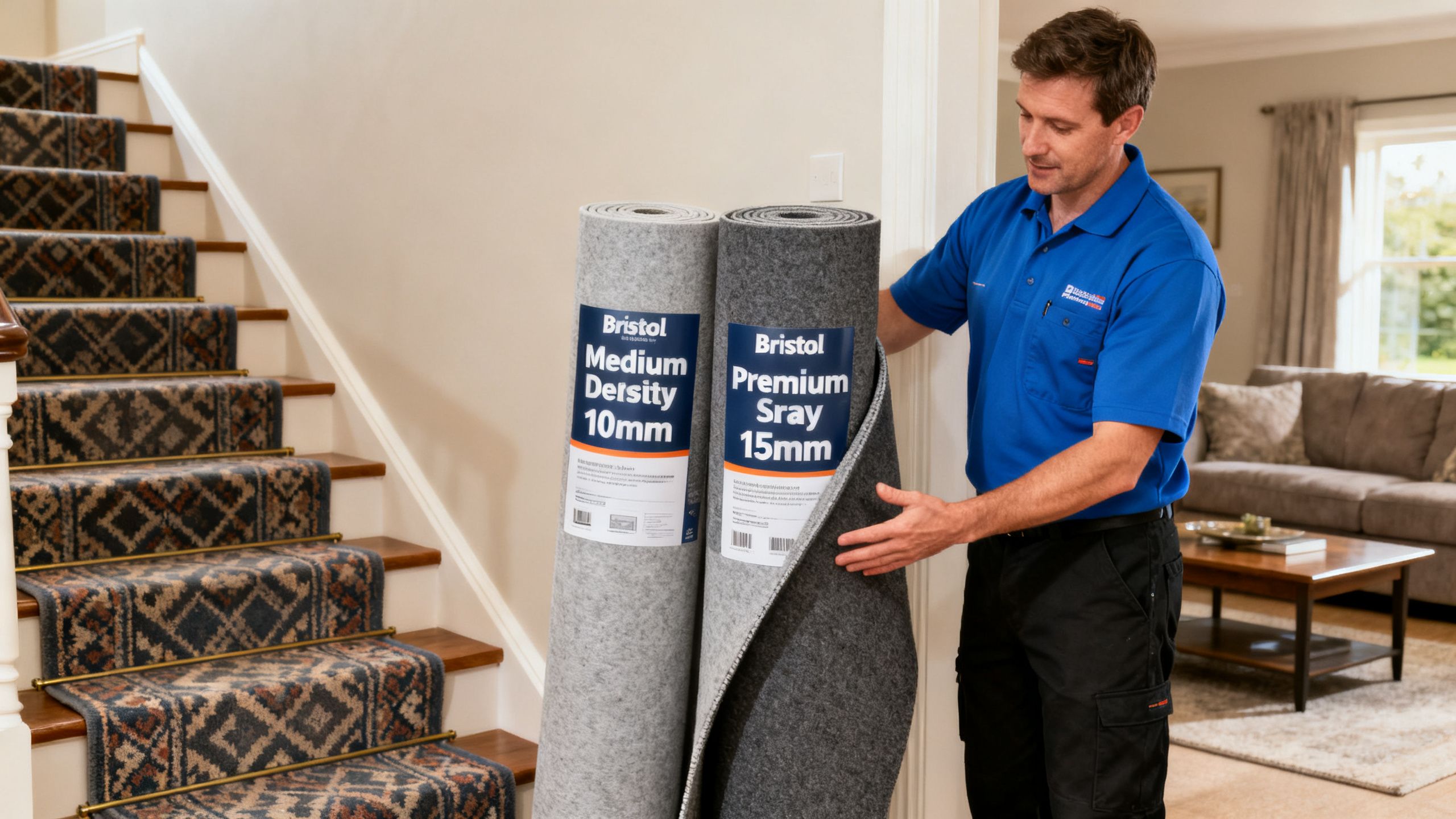
A thick underlay can feel impressive in a showroom because it compresses easily under your hand. That does not automatically make it the best foundation beneath a carpet. A denser medium-thickness underlay supports the carpet more consistently. It resists excessive movement, holds its shape and gives the carpet backing a stable platform. A very soft, low-density product can be thicker but less supportive. This is why we look at density and recovery as well as the number of millimetres. A good 10 or 11mm PU foam underlay can outperform a thicker, cheaper product that collapses under repeated foot traffic. The same principle applies when choosing a carpet. Our guide to carpet types, brands and fitting in Bristol covers the difference between common twist pile and other options, including how they cope with everyday use.12mm everywhere causes real problems
Twelve millimetres is not inherently bad. It can be a comfortable choice in the right room. The problem is treating it as a universal rule. On stairs, thick soft underlay can make the carpet sit awkwardly over the tread and riser. It may roll around the nosing, feel unstable and make accurate fitting more difficult. For most staircases, we prefer a firmer underlay around 8–9mm, subject to the carpet manufacturer’s instructions. Extra thickness also raises the finished floor level. That can mean:- doors catch on the carpet;
- cupboard doors need adjusting;
- thresholds no longer meet neatly;
- skirting and door bars sit at an awkward height; and
- transitions between carpet and vinyl, laminate or LVT become more difficult.
The carpet and underlay work as a pair
Carpet and underlay are a system. A decent carpet on a stable, resilient underlay will usually perform better than a budget carpet placed over a very thick but overly soft base. That matters most in hallways, entrances and family rooms. These areas need the carpet to cope with repeated loading, not simply feel soft on day one. A firmer foundation can help the pile recover and reduce the excessive flexing that contributes to premature wear. Always check the carpet manufacturer’s specification before choosing underlay. Brands such as Cormar state recommended or maximum underlay requirements for their products. Going over the stated limit can create fitting problems and may affect the warranty. Manufacturer information is also available through Cormar Carpets.When thick or premium underlay IS worth it
Our position is not that thick underlay is always wrong. There are homes and rooms where paying more genuinely earns its keep. Suspended timber ground floors are a good example. Victorian and Edwardian terraces in areas such as Bedminster, Southville, Bishopston, Cotham, Redland and Knowle can have cold air moving beneath the floorboards. A higher-tog underlay can make the room noticeably warmer. While the floor is exposed, it is also worth checking that airbricks are clear and that there is no damp or timber problem underneath. Upstairs flats and converted houses may need specialist acoustic underlay. If impact noise travels to the neighbour below, choose a product with a suitable acoustic rating rather than simply selecting the thickest foam. The specification matters more than the marketing language. Bedrooms and lounges are often where premium comfort makes sense. If the purpose of the room is to feel warm and luxurious underfoot, a quality 10–11mm underlay can be money well spent. You notice that comfort every day. Concrete subfloors can benefit from a suitable underlay alongside the correct damp protection. The underlay may help with warmth and comfort, but it cannot solve moisture coming through the slab. The subfloor must be assessed and prepared properly first. We would never recommend skipping underlay altogether or automatically reusing old underlay. Once compressed, contaminated or misshapen, it no longer provides the consistent support a new carpet needs. That saving is usually a false economy. Our carpet underlay guide for Bristol homes explains more about comfort, insulation and the conditions underneath the carpet.What we actually recommend instead
Buy for the room, not from a thickness chart. We normally consider the room’s traffic, the carpet specification, the subfloor, door clearance and the customer’s budget together.| Room or situation | What we’d use | Why |
|---|---|---|
| Stairs and busy hallways | A firmer, denser underlay around 8–9mm | Better shape-holding, safer footing and less risk of the carpet rolling over the nosing |
| Bedrooms and lounges | Quality 10–11mm PU foam | A strong balance of comfort, support and insulation for most homes |
| Cold suspended timber floors | An underlay chosen for high tog, with the floor checked | Helps retain warmth; airbricks and the subfloor still need attention |
| Flats with neighbours below | Underlay with an appropriate acoustic rating | Designed to reduce impact noise rather than simply maximise softness |
Do you actually need premium underlay? A quick self-test
Ask yourself these questions before choosing:- What room is it for? A main bedroom or lounge may justify extra comfort. A stairway needs firmness and control. A little-used spare room may not need the highest specification.
- How much traffic will it receive? Children, pets, shoes and repeated routes through a hallway favour a supportive, resilient underlay rather than a very soft one.
- What is beneath it? Concrete may need appropriate damp protection. A suspended timber floor may benefit from a higher-tog product. Neither situation is solved by thickness alone.
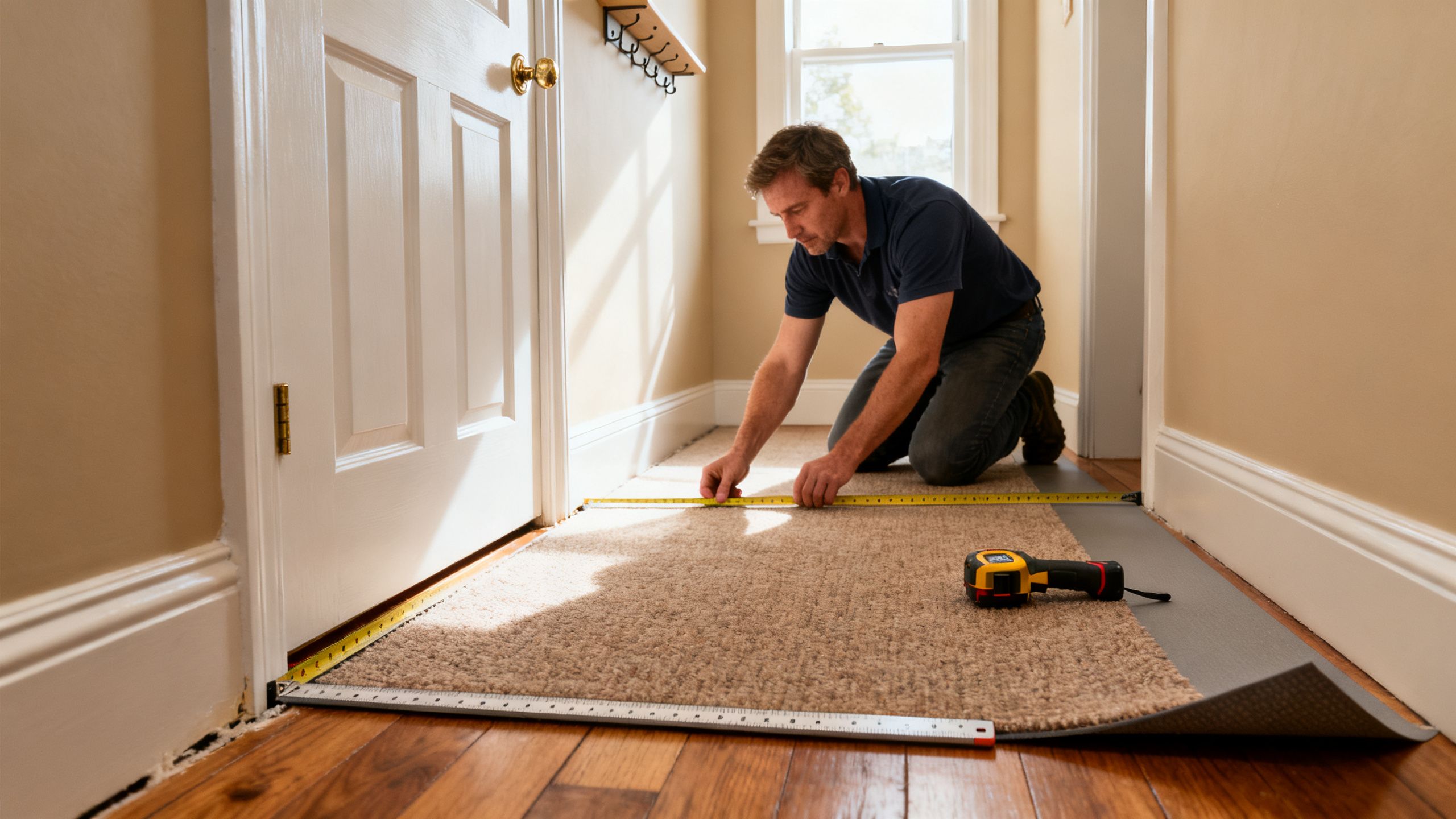
- Will doors and thresholds clear the new floor? Measure before ordering. A 12mm underlay plus carpet can raise the finished level enough to cause avoidable problems.
- What does the carpet manufacturer specify? Check the product data sheet, including maximum underlay thickness and any warranty requirements.
- Where will the next pound work hardest? If the choice is between premium underlay and a better carpet, compare expected wear, comfort and appearance over several years.
- Is the quote suspiciously cheap because the old underlay is being reused? New carpet deserves a clean, stable base. Old underlay may be compressed, contaminated or uneven.
Underlay basics, briefly
Underlay sits between the subfloor and carpet. It cushions footsteps, helps the carpet feel more comfortable, can improve thermal insulation and may reduce airborne or impact sound depending on the product and construction. Common thickness bands are roughly 7–9mm, 10–11mm and 12mm. The thickest band is not automatically the best. Thickness should be considered alongside density, resilience, tog, acoustic performance and the carpet manufacturer’s requirements. PU foam is light, comfortable and widely used in homes. A good dense PU product around 10–11mm suits many bedrooms and living rooms. Crumb rubber is heavier and can offer useful resilience and acoustic performance, although the right product still depends on the room and carpet. Tog indicates thermal resistance. It can be particularly relevant over cold suspended timber floors, but a high tog rating is not the same thing as maximum thickness. Acoustic ratings should be checked separately where neighbour noise is a concern. On stairs, the usual rule is to prioritise a firmer, thinner product—often around 8–9mm—so the carpet can be shaped securely around the tread, riser and nosing. Always follow the carpet manufacturer’s instructions and have the finished floor level checked against doors and adjoining surfaces. For technical fire performance information, including relevant carpet and flooring requirements, consult the British Standards guidance for BS 5808, as well as the manufacturer’s own specification for the carpet and underlay.