




After fitting around 400 LVT and laminate floors in Bristol over the last five years, our honest finding is that LVT nearly always costs less to own than laminate, even though it costs more to buy. Most early replacements we see are laminate floors damaged by water at a joint, while LVT is usually the safer long-term choice when moisture, noise or durability matters. Seamless Floors fits both, so this is a fitter’s view rather than a sales pitch.
How we know: fitting both across around 400 LVT and laminate floors over the last five years
We’ve fitted around 400 LVT and laminate floors across Bristol, Bath and surrounding areas. The split is now roughly 60/40 in favour of LVT. Ten years ago, it was the other way round: laminate was the default and LVT was considered the upgrade.
We judge floors by what happens beyond the fitting day. That means looking at how straightforward they are to install, how they cope with real households, what customers report back, and which floors we get called to repair or replace. We also see the subfloors hidden underneath older Bristol terraces, where preparation often matters more than the product name.
That experience matches what we say in our wider guide to the best flooring options for Bristol homes: the right material depends on the room, the subfloor and how the property is used.
What every comparison guide says vs what we’ve found
What guides say | What we find fitting them |
|---|---|
LVT is waterproof but more expensive. | The higher purchase price can be offset by fewer water-related replacements. Laminate boards swell permanently after water gets into the HDF core. |
Laminate is cheaper and warmer. | Laminate is usually cheaper and can feel pleasantly warm, but it can sound hollow or noisy, especially over suspended timber floors. |
LVT is better for kitchens and laminate suits living spaces. | That is broadly right, but subfloor condition, noise, pets, children and whether the floor may need repairing can change the recommendation. |
Both are easy DIY floors. | Laminate is quicker to fit, but expansion gaps are essential. Glue-down LVT takes more preparation and shows imperfections if the floor is not flat. |
The product specifications are useful, but they do not tell you what happens when a dishwasher leaks, when a Victorian floor moves, or when a floating floor is trapped beneath a heavy kitchen unit. Our LVT flooring guide for Bristol covers the product choices, but the fitting conditions are just as important.
The real difference when you fit them
Laminate floats. It sits over underlay, clicks together and moves as one large sheet. That makes it relatively quick to install, but it must have room to move. We leave roughly 10–12mm expansion gaps at walls, doorways and pipes, and avoid trapping it under heavy fixed units. If those gaps are missed, laminate can peak or lift when the room warms up.
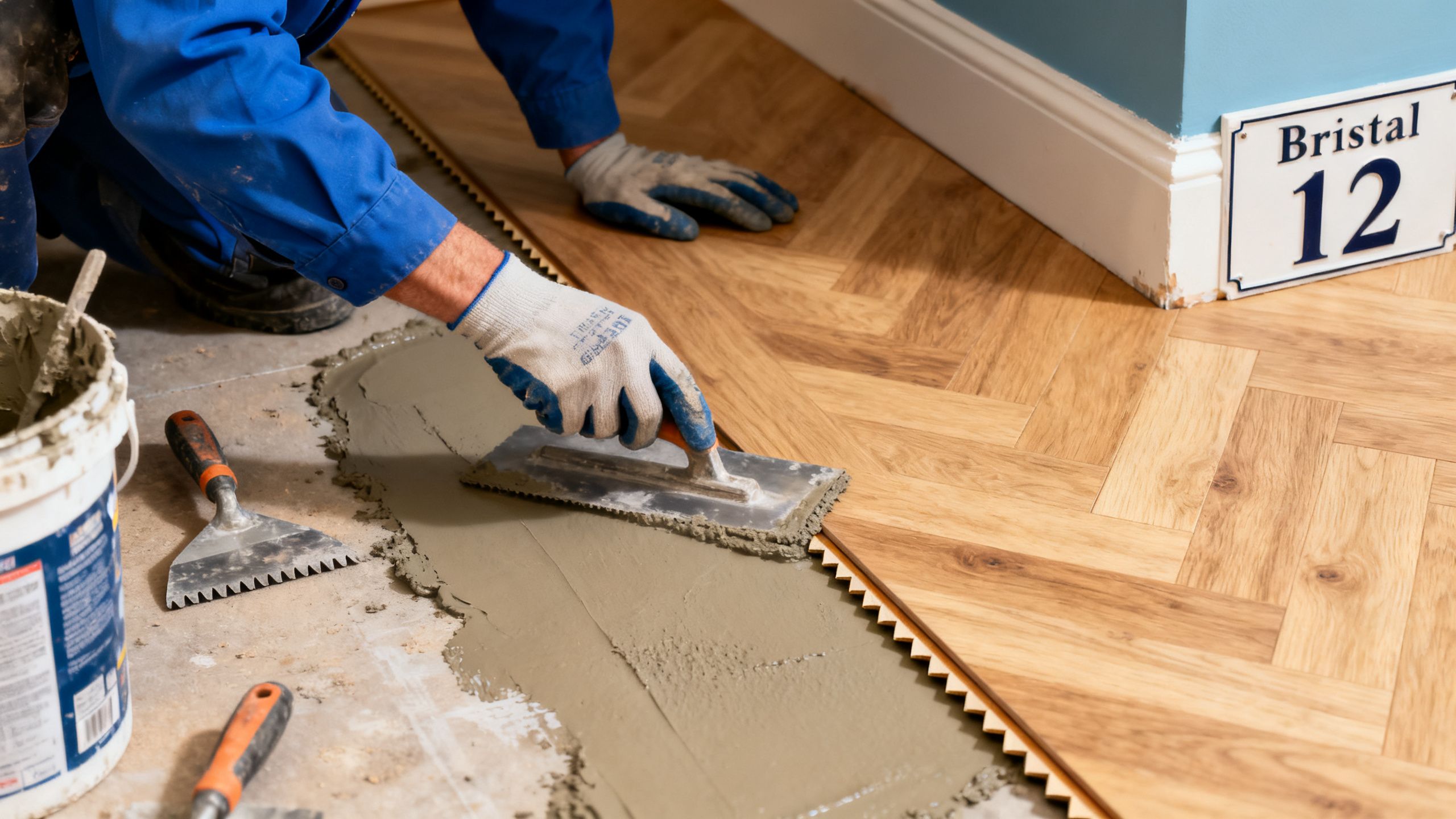
LVT mostly gets stuck down. Glue-down LVT needs a flat, dry and properly prepared subfloor. On an older Bristol floor, that may mean plywood over timber boards followed by smoothing compound. Any bumps, joins or contamination underneath can telegraph through the LVT surface. It is a longer job: a laminate floor might take a day over a suitable floor, while glue-down LVT can take two or three days when drying time is included.
Click LVT sits between the two. It is faster and more forgiving than glue-down LVT, particularly when it has integrated underlay, but it is still not a licence to cover a poor subfloor. In a kitchen, we would generally prefer glue-down LVT where the preparation allows it.
One rule is non-negotiable: you cannot lay LVT directly over existing laminate. The laminate is a floating floor and its movement can make the LVT move, separate or buckle. The laminate needs to come up, and the subfloor must be checked, levelled and made sound first.
Laminate also needs acclimatising in the room, usually for around two days. LVT needs acclimatising too, and skipping that step makes an already less-forgiving installation riskier. Laminate cuts quickly with a saw but creates dust. LVT cuts with a knife, so it is quieter and cleaner in an occupied home.
LVT in practice
The main strength of LVT is that it is practical where spills are likely. A properly fitted LVT floor is well suited to kitchens, bathrooms, utilities and entrance areas. Glue-down LVT also feels solid underfoot because it is bonded to the prepared floor rather than moving over underlay.
It is often easier to repair than people expect. If a plank is badly damaged, a fitter can cut it out and replace it without dismantling half the room. That matters in a busy kitchen or hallway.
The tradeoff is preparation. Glue-down LVT will not hide an uneven floor. If the subfloor is not flat, the finished floor can show every imperfection. Click LVT is more forgiving, but it still needs a stable, level base and careful detailing around edges.
For product and fitting considerations, our guide to vinyl flooring installation in Bristol explains the differences between sheet vinyl, LVT and other vinyl options.
For manufacturer guidance on installation conditions, see Amtico’s installation resources. Always follow the instructions for the specific product being installed.
Laminate in practice
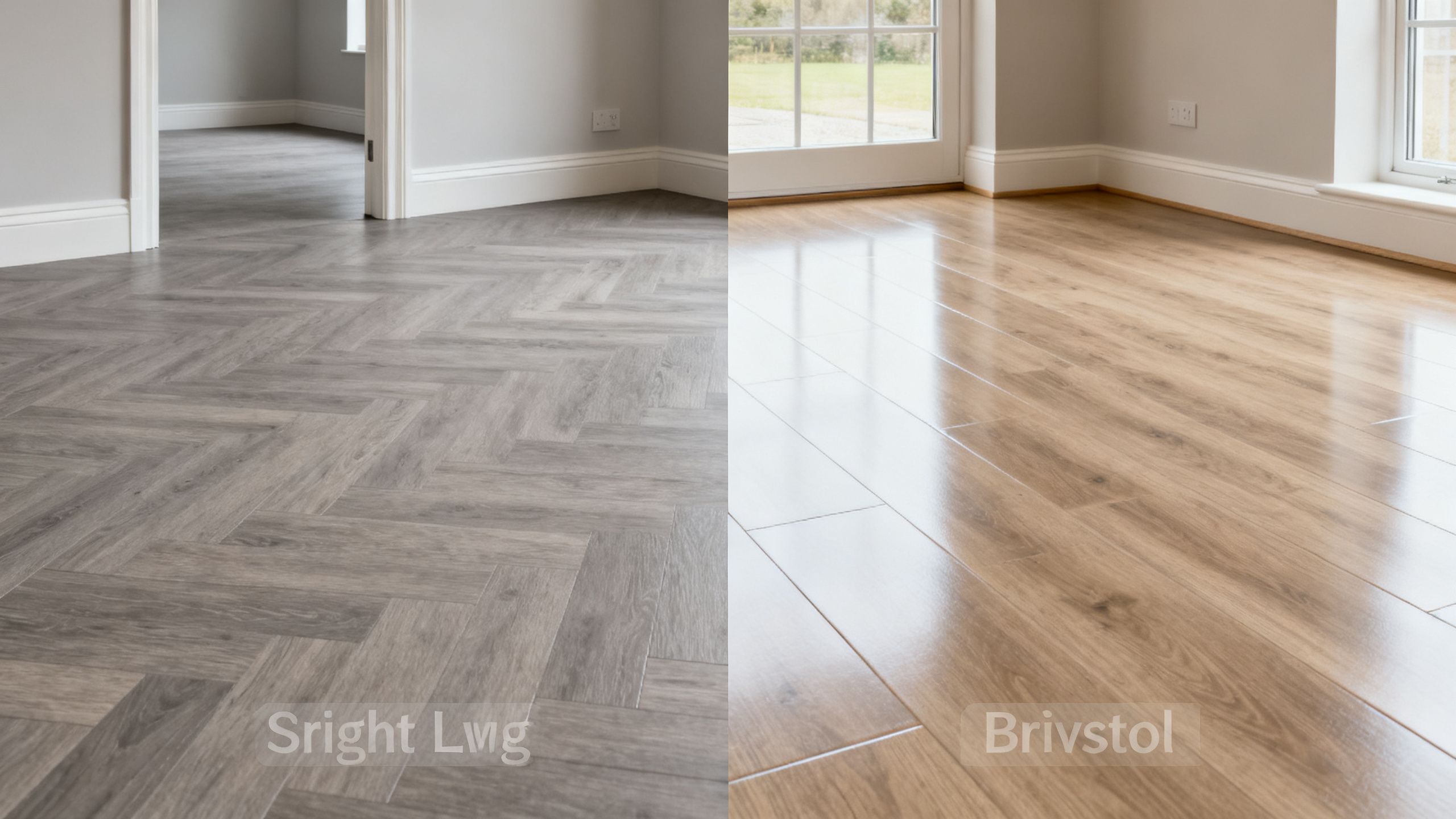
Laminate is a sensible choice when the budget is tight, the room is dry and the installation needs to be completed quickly. A decent product can look very convincing, and a good AC4 or AC5 laminate genuinely tends to resist scuffs better than a softer LVT product.
It is particularly useful for bedrooms, lounges, rentals and quick refurbishments. We can often fit a suitable bedroom or living room in a day, assuming the subfloor is ready.
The weaknesses are moisture and movement. Laminate is not suitable for a bathroom. In a kitchen, it can work only with care and sensible expectations: standing water, leaking appliances and wet mopping remain risks. Once water reaches the HDF core and a board swells, it does not return to its original shape.
It can also sound hollow. Acoustic underlay helps, but laminate over suspended timber floors can still be noticeably louder than glue-down LVT. This is especially relevant in flats and Victorian terraces where sound travels between rooms or to the property below.
The manufacturer’s laminate installation guidance from Quick-Step is a useful reminder that expansion, acclimatisation and subfloor preparation are not optional details.
LVT vs laminate: the factors that actually matter
These scores reflect our fitting experience rather than a universal product guarantee. Quality, installation and the specific room can change the result.
Factor | LVT | Laminate |
|---|---|---|
Waterproofing | Very good for suitable wet areas when correctly installed | Poor to fair; joints and HDF core remain vulnerable to water |
Durability and dents | Very good; resilient, though softer products can mark | Good; hard surface resists many knocks, but damaged boards cannot be restored |
Scratch resistance | Good, depending on wear layer and product | Very good with a good AC4 or AC5 product |
Feel and warmth | Solid and comfortable, especially over UFH; can feel less warm without heating | Warm and familiar over underlay, but can feel less substantial |
Sound and quietness | Very good, especially glue-down LVT | Fair; underlay helps but hollow sound can remain |
Ease and quality of fitting | More demanding, particularly glue-down; excellent when prepared correctly | Quicker, but poor expansion detailing causes failures |
Subfloor forgiveness | Low for glue-down; medium for click | Medium, provided the floor is reasonably flat and stable |
Repairability | Very good; individual planks can often be replaced | Limited; replacing a middle board may mean lifting much of the floor |
Price and value | Higher purchase cost, often better long-term value in demanding rooms | Lower purchase and fitting cost, good value in dry, lower-risk rooms |
Wear-layer thickness matters with LVT. A thicker wear layer can be useful in busy areas, but it does not remove the need for a flat subfloor or careful fitting. Laminate quality is influenced by the board construction, surface rating and edge protection, not just the appearance on the sample.
Where each one genuinely wins
LVT wins in kitchens, bathrooms, utilities and other areas where water is a realistic possibility. It also wins over underfloor heating, in flats and terraces where noise matters, and in homes where the floor is expected to last around 20 years. The subfloor preparation costs more, but it gives the finished floor a solid, quiet feel.
Laminate wins on price and speed. It is a strong option for a bedroom or lounge where the room is dry and the budget is the priority. It also makes sense for a rental or quick turnaround where a good-looking floor is needed without the cost of extensive preparation. If you are not staying in the property, the ability to lift a floating floor can be useful too.
Laminate’s scratch resistance is a genuine advantage. A good AC4 or AC5 product can take everyday scuffs better than a softer LVT. It is also closer to LVT than many people realise for realistic wood effects; a good laminate can look more convincing than a cheap LVT.
Our preferred floor is not always the pricier one. Glue-down LVT is a poor choice if the preparation budget is too low, and laminate is perfectly sensible in the right dry room. Both need a sound subfloor.
Price and value: is LVT worth the extra?
As a broad UK guide, laminate is often around £8–£30 per m2, while LVT is commonly around £15–£45 per m2. Herringbone layouts generally cost more because they use more material and take longer to set out and fit. Preparation, uplift, trims, doors and subfloor repairs can add substantially to the final price.
Our guide to LVT flooring costs in Bristol explains why a like-for-like quote needs to include the floor beneath the product, not just the price per square metre.
LVT is worth paying extra for where a laminate replacement would be likely: a kitchen with a dishwasher, a busy hallway, a home with underfloor heating, or a flat where noise travels. It can also be better value if you want to repair one damaged plank rather than replace a large floating floor.
Laminate is better value where the room is dry, the floor is reasonably flat and the expected service life is shorter. Across decent products, both can last roughly 10–25 years, depending on quality, traffic, cleaning and installation. The cheapest floor is not always the cheapest floor to own.
Which should you choose, room by room?
Kitchen: Usually LVT, especially glue-down LVT over a properly prepared subfloor. Laminate is more exposed to dishwasher leaks, spills and wet cleaning.
Bathroom or wet area: LVT. Do not use ordinary laminate in a bathroom.
Hallway or high-traffic area: LVT for water resistance, repairability and long-term wear. Good AC4/AC5 laminate can work where budget is the main concern and the entrance is kept dry.
Living room: Either. Choose LVT for quietness and longevity; choose laminate for a lower initial cost and a warmer feel over underlay.
Bedroom: Laminate is often the sensible value choice. LVT works if you want the same continuous floor through adjoining spaces.
Rental: Laminate usually wins for low initial cost, fast fitting and ease of lifting. LVT is worth considering in kitchens and entrances.
Pets and children: LVT is safer around spills and easier to repair; a good laminate can be very scratch-resistant. The decision depends on whether accidents are wet, abrasive or both.
Underfloor heating: LVT is generally the better fit, subject to the product’s instructions and correct installation. Always check the specified temperature and resistance limits.
Best for kitchens, bathrooms and high-traffic
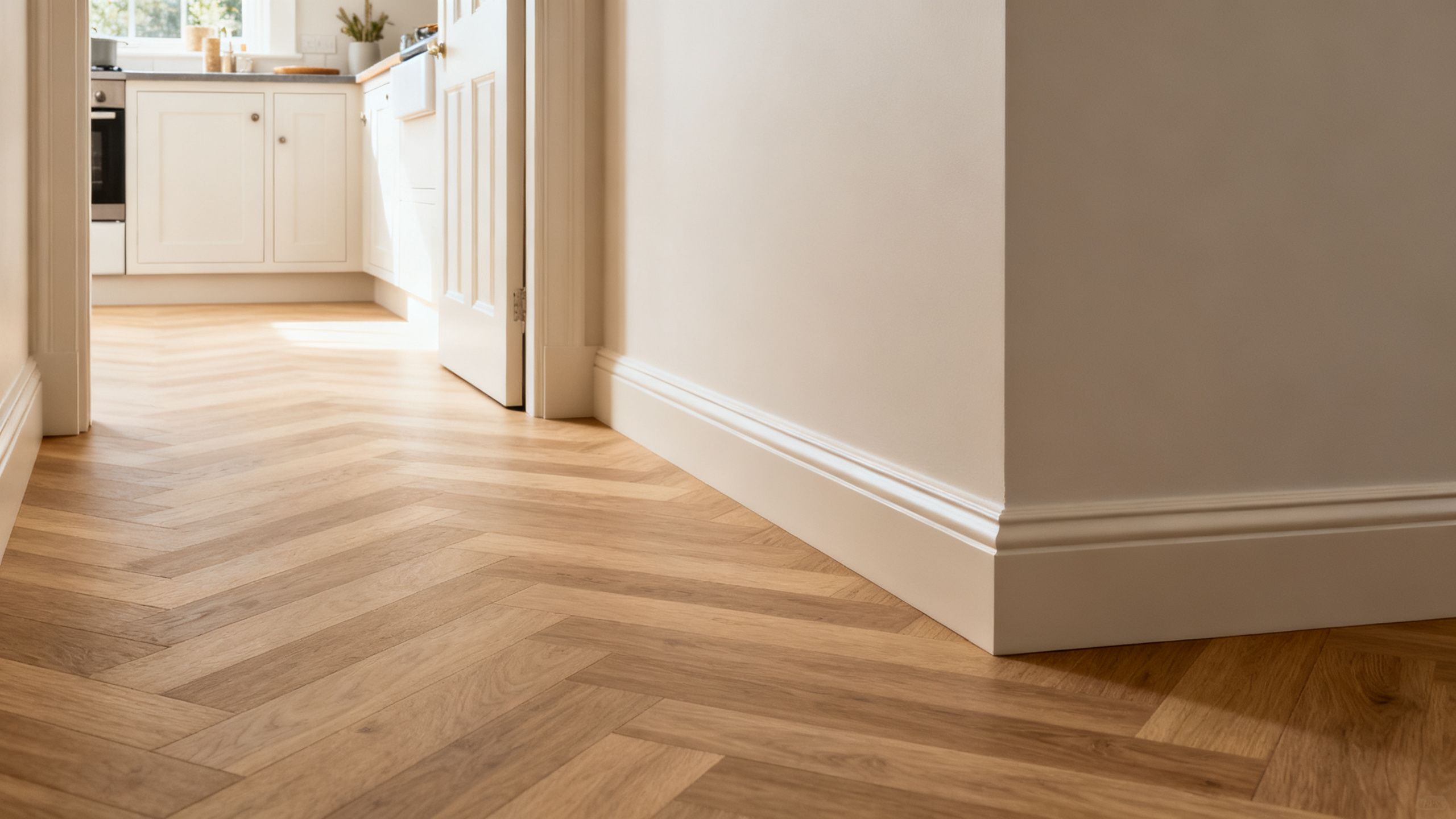
Choose LVT when the room faces regular spills, wet shoes, heavy footfall or cleaning. It is especially useful where a damaged plank may need replacing later. In kitchens, we prefer a correctly prepared glue-down installation, although suitable click LVT can be the practical answer where the existing conditions support it.
For a comparison of vinyl choices and their practical uses, see our guide to what actually works best for vinyl flooring in Bristol.
Best for bedrooms, lounges and budget
Choose laminate when the room is dry, the budget is important and you want a quick installation. It gives a good appearance for less money and a quality surface can handle everyday scratches very well. Keep the expansion gaps, use suitable underlay and do not allow water to sit around joints.
A bedroom or lounge does not automatically need the more expensive floor. A well-fitted laminate is a perfectly respectable choice in the right room.
Our verdict
If there is any chance of water, underfloor heating, neighbours below or a requirement for the floor to last, we would choose LVT and spend the money on subfloor preparation rather than the fanciest range.
If it is a bedroom, lounge or rental, and budget is the driver, a decent laminate is a sensible floor. Anyone who says laminate is always a bad choice is selling rather than advising. Just leave the expansion gaps and do not put it in a bathroom.
Seamless Floors supplies and fits both LVT and laminate across Bristol, Bath and surrounding areas. We recommend by room, household and budget, not by brand loyalty. Call us on 07901751755 if you want us to look at the floor beneath the floor as well as the samples.
LVT vs laminate FAQ
Is LVT better than laminate?
LVT is better where water, noise, underfloor heating, repairability or long service life matters. Laminate is better value in dry rooms where the budget and fitting speed matter most.
Which is more durable?
Both can last around 10–25 years depending on quality and fitting. LVT usually copes better with moisture and can be repaired plank by plank. A good AC4 or AC5 laminate can resist scratches very well.
Which is cheaper?
Laminate is usually cheaper to buy and fit, often around £8–£30 per m2. LVT commonly costs around £15–£45 per m2 before preparation and fitting. LVT can still cost less to own if laminate is repeatedly damaged by water.
Can you put LVT in a bathroom?
Yes, suitable LVT can be fitted in a bathroom, provided the product and installation method are appropriate and the subfloor is sound, flat and dry. Seams and edges still need careful detailing.
Can laminate go in a kitchen?
It can, but it carries more risk than LVT. A dishwasher leak, wet mop or standing spill can reach the joints and swell the HDF core. We would not use ordinary laminate in a bathroom.
Can you lay LVT over laminate?
No. Existing laminate is a floating floor and its movement can make the LVT buckle or separate. Remove the laminate, inspect the subfloor and prepare it properly before fitting LVT.
Which is warmer and quieter underfoot?
Laminate can feel warm over underlay, but it can sound hollow, particularly over suspended timber. Glue-down LVT feels more solid and is generally quieter, which is useful in flats and terraces. Underfloor heating can improve the warmth of LVT where the product allows it.
Which do you recommend?
We recommend LVT for wet areas, underfloor heating, noisy properties and floors that need to last. We recommend laminate for dry bedrooms and lounges, rentals and projects where the initial budget or speed matters more. For advice based on your actual room, call Seamless Floors on 07901751755.
Get LVT or laminate fitted in Bristol, Bath and surrounding areas
Seamless Floors supplies and fits both LVT and laminate across Bristol, Bath and surrounding areas, with honest advice on the material, preparation and budget that suit your room. Call 07901751755 or use our vinyl flooring service page to arrange a free, no-obligation discussion.